Mostrando las entradas con la etiqueta EM. Mostrar todas las entradas

sábado, 1 de julio de 2017

The Water Cycle

Here there is kind of a summery I made about the water cycle: It’s definition, how it happens and what is the problem that’s affecting this process.


The hydrological cycle, better known as the water cycle, is the process that recycles water and nutrients. It’s the continuous exchange of water between land and water-bodies.
It begins when water from differents places (oceans, rivers, lakes, ponds, puddles, etc) evaporates going up to the sky and formed into clouds while being cooled. So once clouds are filled with more water, precipitation occurs, and waters comes back (in form of rain, ice, sleet or snow) And now just 2 things can happen: Water could become part of the ground, flowing into oceans or lakes by rivers and streams. Or it just could go back up to the atmosphere and the cycle begins again.

It is very important for this to occur because it gives fresh water to every living being in the world. Approximately 97% of the earth’s water is stored in the oceans, and only a fraction of the remaining portion is usable freshwater. So if the urbanization alter the natural amount of water that should go into ocean and lakes, the consequences could be a decrease in the volume of water that percolates into the ground and in the quality of water as well. These type of hydrological changes actually ARE having significant implications for the quantity of clean and fresh water that is available for the use of humans and wildlife.

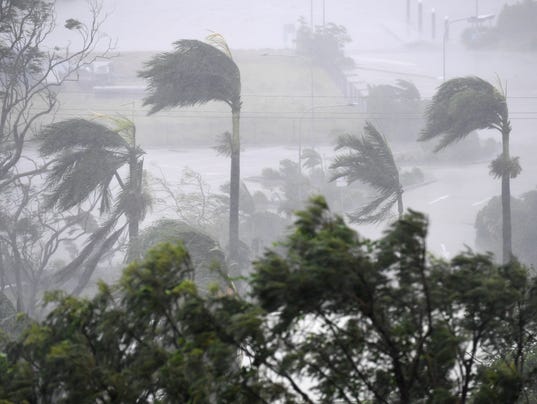
Australia’s Cyclone

Almost a month ago, a powerful cyclone threatened northern Australia, damaging homes, wrecking jetties and cutting power to thousands of people. Despite issuing evacuation orders, police told Reuters they were not sure how many people had heeded their advice the day before (Monday 27th) Although only about 400 people went to cyclone shelters as the winds gathered strength, making it more dangerous, it could have been the biggest evacuation seen in Australia since Cyclone Tracy devastated the northern city of Darwin on Christmas Day, 1974. Townsville airport was closed and airlines Qantas, Jetstar, Rex and Virgin Australia cancelled several flights. Authorities said it was too dangerous to venture outside and risk to receive damage. Emergency response crews were also sheltered until the storm finished. The wind gusts were stronger than 260 km per hour confirming that it was a category 4. Also the torrential rain flooded streets and wind smashed windows, uprooted trees and tossed debris through streets, cutting roads and leaving residents climbing into roofs and floating down streets in boats. All this happened during March 27th and 31st.

lunes, 23 de noviembre de 2015

Types of rocks

This is a presentation about the different types of rocks: igneous, sedimentary and metamorphic.

Powered by emaze

ROCKS: Gabbro, Limestone and Shist

This entry has a mind map and a video that talks about these three rocks: gabbro (igneous rock), limestone (sedimentary rock) and schist (metamorphic rock).


Mapa Mental creado con GoConqr por M.G.L

lunes, 16 de noviembre de 2015

Scacht Konrad

Hi guys, here I leave a Google Presentation about th iron ore mine, Schacht Konrad, located in Germany. I hope you enjoy it! :) (On the presentation there are just key words. So if you want to read the complete information, it is down the presentation... 

Here is the complete information from each slideshow of the presentation:

The pit Konrad or Schacht Konrad is a former iron ore mine proposed as a deep geological repository for medium- and low level radioactive waste.

Location: it is located in the city Salzgitter in the Metropolitan region Hannover-Braunschweig-Göttingen-Wolfsburg in southeast Lower Saxony, Germany, located between Hildesheim and Braunschweig. It has two shafts: Konrad I and Konrad II.

Human conditions: With regard to safety issues: in 1987, three different expert opinions were given which argued that Schacht Konrad is not at all appropriate as a final repository.
Workers will be exposed to radiation much more than the normal population, meaning that a railroad worker will be allowed to receive the same amount of radiation every nine minutes which other people are allowed within a year.

History: The first activities on this place began in 1867. The shaft Konrad is the youngest of the former iron ore mines in this region.The mining operation on Konrad lasted from 1961 to 1976. During this period, a total of 6.7 million tonnes of iron ore were retrieved.

The shaft Konrad is an unusually dry iron ore mine. This is one of the criteria for a deep final repository for radioactive waste, the studies on the possibility of a disposal site were started in 1975.

viernes, 20 de junio de 2014

Information and pictures of Greenland

Information and pictures of  Greenland with "Scribble Maps".

http://www.scribblemaps.com/create/#lat=78.48019759707148&lng=-41.371175585937515&z=3&t=hybrid
